

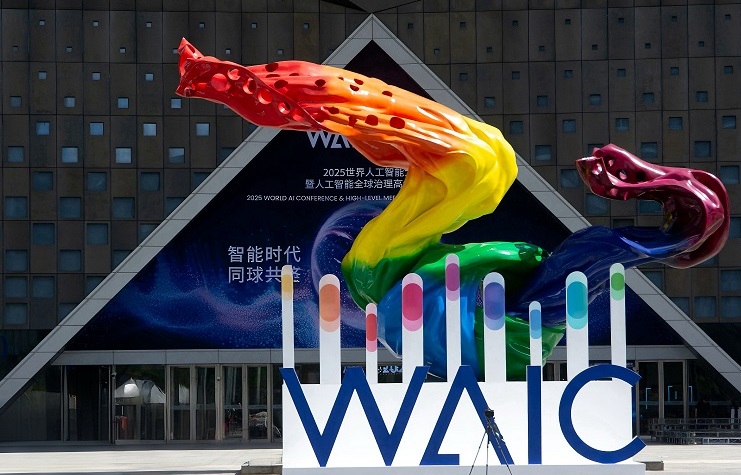
China is rapidly reshaping the artificial intelligence landscape by launching cost-effective AI models, building self-reliant technology ecosystems, and championing a new global framework for AI governance. As Western sanctions tighten and competition accelerates, Beijing is positioning itself as a global leader not just in innovation, but in setting the ethical and regulatory agenda for artificial intelligence.
At the recent World Artificial Intelligence Conference (WAIC) in Shanghai, Chinese startup Z.ai (formerly Zhipu) unveiled its latest large language model, GLM‑4.5, which promises high performance at a fraction of the cost of its rivals. Designed to run on just eight Nvidia H20 chips—half the infrastructure needed for models like DeepSeek—GLM‑4.5 slashes operational costs while maintaining comparable capabilities. It charges only 11 cents per million input tokens and 28 cents per million output tokens, significantly undercutting DeepSeek’s pricing and making advanced AI more accessible to users across industries.
This push toward affordability is part of a larger movement in China’s AI sector. Tech giants such as Baidu and startups like Moonshot AI and 01.AI are embracing open-source licensing and releasing low-cost, high-performing models. Baidu’s Ernie 4.5 and DeepSeek-R1 are setting new benchmarks for cost-efficiency, signaling a broader shift away from billion-dollar compute-intensive models toward more pragmatic solutions that scale.
Simultaneously, China is building a robust domestic AI-chip ecosystem in response to escalating U.S. export restrictions on advanced semiconductors. Leading AI developers have formed strategic alliances with chipmakers like Huawei, Biren, and Moore Threads to create the “Model-Chip Ecosystem Innovation Alliance.” This initiative seeks to seamlessly integrate model development with indigenous chip design, infrastructure, and cloud platforms.
Innovations from the WAIC underscored this self-sufficiency strategy. Huawei showcased its CloudMatrix 384 platform—powered by proprietary chips—that rivals top-tier Nvidia hardware. Tencent demonstrated its Hunyuan 3D World Model, which generates interactive 3D scenes from text and images, while Baidu unveiled new digital human technology capable of mimicking human voice and body language from minimal data. Alibaba introduced Quark AI Glasses, designed for intuitive navigation and payment interactions through its Qwen AI model.
These technological strides are accompanied by a broader diplomatic initiative. Chinese Premier Li Qiang used the WAIC platform to propose the formation of a global AI governance body. Stressing the risks of monopolization by a few countries or corporations, Li called for international collaboration under the principles of “extensive consultation, joint contribution, and shared benefits.” China has introduced a 13-point action plan aimed at fostering global cooperation, supporting open-source development, and empowering the Global South through AI partnerships.
In contrast to the U.S., where the newly elected Trump administration favors a low-regulation strategy for AI, China is advocating for a more structured and inclusive governance model. This divergence sets the stage for a global debate on how AI should be developed, deployed, and regulated.
By championing affordable AI, fostering a resilient domestic technology ecosystem, and advocating for international regulatory cooperation, China is not only closing the technological gap—it’s attempting to redefine the rules of the game. As AI continues to shape the future of economies, industries, and societies, Beijing is staking its claim as both a technological and ethical superpower in the AI age.
